

|
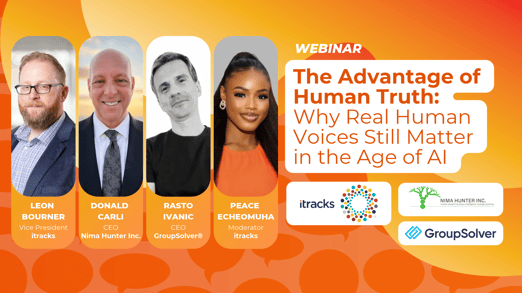
Don Carli, Co-founder and President of Nima Hunter Inc., describes himself as a "research architect." His consultancy helps organizations answer critical business questions related to branding, product development, market positioning, and organizational strategy. Rather than relying on a single methodology, Don combines desk research, intent data, qualitative research, quantitative validation, and expert panels, including Delphi studies. He starts from the decision the client has to make and designs the research to fit it. He’s a long-time valued partner and client of itracks, and one of the first researchers to use itracks Board asynchronous focus groups. We sat down to chat with Don about what sets his work apart, why he chose itracks Board, what kind of clients find his work most valuable, and why he thinks human moderation is so important. |
What does Nima Hunter do?
"Nima Hunter is a research consultancy. Effectively, we provide competitive intelligence, desk research, qualitative and quantitative insight services to a pretty broad array of clients, many of them B2B."
Nima Hunter Inc. specializes in helping business leaders and marketing executives identify new product and market opportunities, assess emerging issues, evaluate competitive challenges and build strategies for growth. Nima Hunter, Inc. typically works with CMOs, marketing VPs, and brand and product managers. Their decisions on branding, positioning and new products are often hard to reverse. The cost of being wrong can run to millions of dollars in sales, market share or reputation.
Why itracks?
According to Don, for busy executives and industry specialists, asynchronous participation often works far better than scheduled focus groups or one-on-one interviews.
"I was always looking for more effective ways to apply technology to research. I saw the benefit of the asynchronous bulletin boards immediately because of the difficulty of recruiting B2B participants, especially higher levels of management."
Another reason Don chose itracks Board was its openness. He uses GroupSolver to recruit and verify participants. Then he runs GroupSolver survey exercises inside the board with the same people. The itracks team’s flexibility made that integration possible.
“One of the reasons I choose itracks is because of the flexibility they’ve exhibited in integrating GroupSolver into the boards.”
itracks' status as an independently owned software company with an open API means that custom solutions are always possible for those who haven’t found what they’re looking for in the more cookie-cutter offerings.
Why is using something like itracks Board particularly valuable for difficult B2B audiences?
Nima Hunter specializes in research with hard-to-reach decision makers, including the C-suite. These are people whose free time is scarce, and who may have an especially tough time committing to a specific hour on a specific day. Still, they have incredibly valuable insight, and uncovering that insight is key to ensuring Nima Hunter Inc.’s clients have the information they need to make good business decisions.
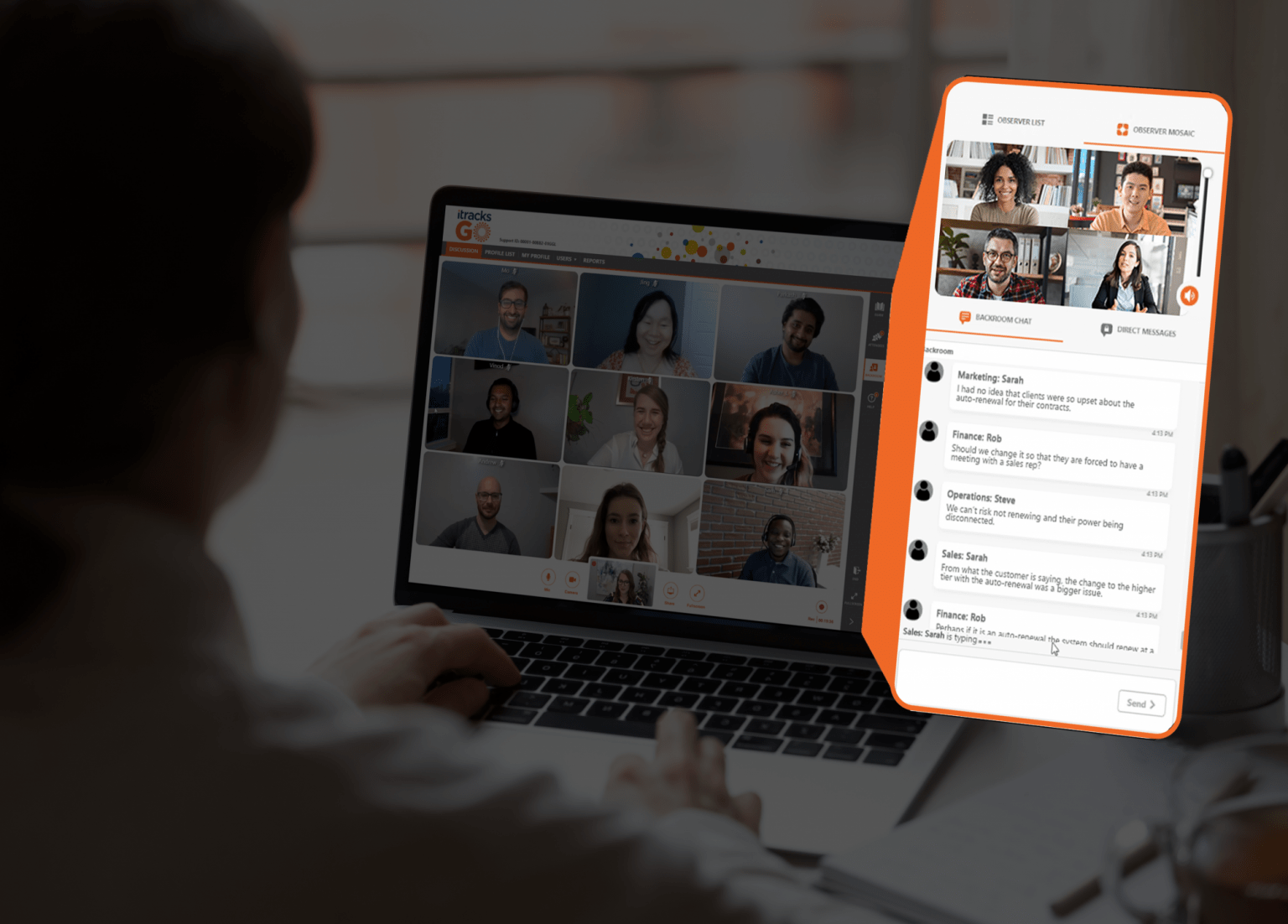
Asynchronous discussions allow these participants to contribute when they have a few minutes (even if it’s when everyone else is asleep) rather than requiring attendance at a fixed meeting time, and allow for follow-ups down the road based on other participants’ responses. Additionally, having a browser-based solution eliminates a lot of the hassle involved in downloading third-party software, especially in large corporations where firewalls and VPNs are the norm.
Verification matters, too. Don often identifies in market prospects through Bombora intent data and open source intelligence (OSINT). He then recruits and qualifies participants through GroupSolver before they join the board. Over several days of discussion, he can go back to anyone whose answers don’t add up.
What business challenge does itracks help Nima Hunter solve?
"Each IDI is a couple of grand. And they'd need to do 15 or 20 or 30. It's a massive time consumption."
Many of Nima Hunter Inc.'s clients traditionally relied on large numbers of in-depth interviews (IDIs) for their qualitative research projects. These come at a huge cost, both in terms of time and money, and are limited in that you typically only get to speak to each participant once. For many of these studies, Don recommends an itracks bulletin board focus group instead. He still uses IDIs and expert interviews when the question calls for them.
"I tell them, I think I can provide you with most, if not all, of the insight that you derive from these face-to-face interviews through a different mode of interaction using bulletin board focus groups."
How do clients benefit from this approach compared to more traditional IDIs or focus groups?
According to Don, speed is one of the biggest benefits.
"I'm able to recruit and get three days of fast and slow thinking, verbatim responses with deep probes and a quantitative spine of research questions from the survey in a matter of two to three weeks. It would take them two months to recruit and interview half the number of people."
Don designs each board to capture quick gut reactions and slower, considered answers. GroupSolver survey exercises inside the board supply the quantitative spine. Clients get answers while the decision is still open, and they keep the depth of qualitative research.
How does Nima Hunter combine qualitative and quantitative research?
One of Don's signature approaches is integrating qualitative exploration with quantitative validation.
It runs in three connected stages. First, Don frames the decision with desk research, intent data and expert input. When the question turns on expert judgment, that input can be a full Delphi study.
Second, he writes the discussion guide and moderates an itracks bulletin board. Inside the board, GroupSolver exercises add a quantitative spine. They include MaxDiff, discrete choice conjoint, NPS, Van Westendorp pricing and AI Open-End™ questions. A MaxDiff exercise can narrow roughly 30 things participants raised to the 8 to 10 that matter most to buyers.
Third, those findings often shape larger quantitative studies, often fielded on GroupSolver. They test how widely the findings hold .This process gives clients both:
- The "why" behind customer behavior, and
- A measure of how widely those views hold across the market, so they can act on the decision with confidence. The client is able to follow along throughout the whole process, first as an observer in the board, and then by viewing results in a live dashboard.
When does Nima Hunter recommend a Delphi study?
Some questions are about where a market or a technology is headed. For those, expert judgment often matters more than buyer opinion. That’s when Don recommends a Delphi study. A Delphi study gathers judgments from a panel of experts over several anonymous rounds. After each round, panelists see a summary of the group’s answers and can revise their own. RAND developed the method in the 1950s. It has since been used in health care, education, management and environmental science. Like a bulletin board, a Delphi study can run online, so senior experts can take part on their own schedule. Don designs the rounds and moderates the panel. His report shows where the experts agree and where they still differ.
What role does human moderation play?
For Don, moderation is where many of the most valuable insights emerge.
“One of the purposes of research isn't just to answer questions, it's to raise them.”
Don uses generative AI where it helps. He treats it as a hypothesis engine, and he uses it to pretest survey instruments before fielding. But he doesn’t think AI can moderate a focus group well, at least not yet. Many of the most important insights he’s found for clients didn’t come from the first question in the discussion guide. They came from noticing something intangible and following up on it.
"Someone will say something in the group, and I’ll tap them on the shoulder with a DM and ask what they meant. Or if someone has been especially quiet, I can dig into that?"
Don moderates in-person and online focus groups, bulletin board focus groups and Delphi panels. He has run groups in the US, the UK, Germany and France. He designs each study and moderates it himself, so the person asking the follow-up questions knows the decision the client faces. That lets him chase nuance as it comes up and draw out quieter participants.
Let’s hear an example of when research turned up something unexpected.
“I can’t name the client, but they had a very specific problem. They had a group of products that represented about $6 billion a year in revenue, and they knew their market share, which was significant. But for three quarters in a row, they were losing two share points each quarter. Each share point was worth about a quarter of a billion dollars. The CMO told the president of the division, ‘I’ve got things under control. We know what’s going on. We’re handling it.’ But the numbers kept trending in the wrong direction.
So I was called by the president, who had seen some work I’d done for another group within the company. He said, ‘Look, I need root cause understanding. What are the factors contributing to the decline? And I need to know what we need to do to reverse the trend within two quarters. We’ve got a bunch of people who have opinions, but nobody’s got data. I need you to get me ground truth.’
We had planned face-to-face groups, but 911 prevented me from flying for a while, so we couldn’t finish them in time. I had groups to conduct in several countries, and an issue surfaced in one of them. Management had chosen a product name without checking its cultural significance. I ran one group each in the UK, Germany, and France, and three in the US. In London, participants reacted strangely. Something felt off, but I couldn’t pinpoint it. I said, ‘I think this name is a problem,’ though I couldn’t explain why.
When the airports opened up, I went to London and ran a face-to-face group because of the suspicion that had been raised in the online one. It turned out the acronym for the name they’d chosen was TOSS. They wouldn’t even say it in the physical room, because they said it wouldn’t be correct to do that in mixed company. They told me, ‘Look, the first time the thing doesn’t work, they’re going to call it a “tosser” which in British slang is a stupid or unpleasant person. It could have been a multi-million-dollar disaster if they would have gone ahead with that. There are always surprises that emerge.”
For Don, the most important findings are often the unexpected ones.
"It’s the surprises, the outliers. Those are what you have to watch for, and what you go looking for.”
That philosophy sits at the center of both his work and his use of the itracks platform.
How do you define the value of research?
Don views research as a tool for reducing uncertainty and business risk. When done properly, the cost of the research project itself is far outweighed by the potential losses of a poorly informed, risky business decision.
“For executives deciding whether to invest in research, I start top-down. What are the business objectives? Which decisions would be difficult or impossible to reverse? What would a wrong call cost you in time, money and reputation? That’s what the research is worth.
A compromised fifth of a $50,000 study is a problem. A compromised fifth of a $5 million product launch is a disaster.”
The Impact
Using itracks, Don Carli and Nima Hunter help clients:
• Complete fieldwork in 2 to 3 weeks instead of about 2 months
• Hear from roughly twice as many participants as a comparable IDI program
• Get three days of moderated discussion with each participant, instead of one interview
• Narrow down 30ish issues to the 8 to 10 that matter most
• Recruit and verify participants before they join the board
• Avoid potential business disasters by doing things like catch a problematic product name before the crucial launch
As Don puts it:
"I ground all of my recommendations and advisory work in research that informs and de-risks decisions."
With itracks Board, Nima Hunter’s clients hear from more of the right people, in weeks instead of months
Need help designing research for a decision that’s hard to reverse?
Don Carli and Nima Hunter design qualitative, quantitative and mixed-method research, including Delphi studies. Don also moderates bulletin board focus groups, online and in-person focus groups, and Delphi panels.
Email Don at carli@nimahunter.com or connect with him on LinkedIn.
Want to hear more from Don and itracks? Click below to access a full recording of this webinar-on-demand.