



What If Your Insurance Customers Are Using AI to Understand You Better Than You Understand Them?
That is not a hypothetical. It is what the data is showing right now, and it is one of the most revealing signals about where the relationship between insurers and their customers actually stands.
Consumers are downloading apps from carriers they have never heard of just to get a quote. They are using AI to decode policy language their insurers have never bothered to simplify. They are switching faster, demanding more, and trusting less. And the insurers who are not paying attention to why this is happening are losing ground they do not realize they are losing.
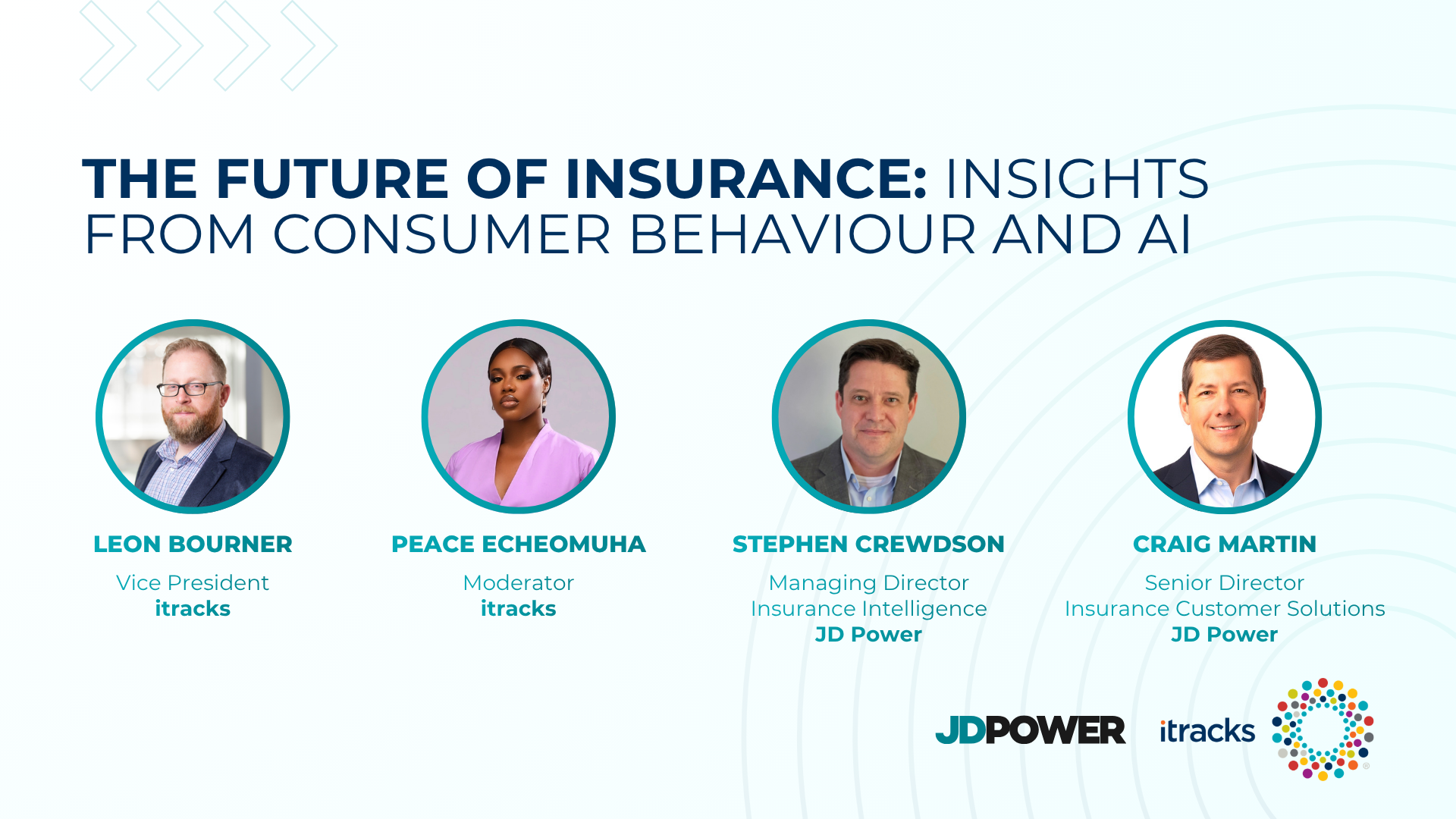
These insights come from a live conversation between three of the most informed voices in the industry right now. Stephen Crewdson, Managing Director of the Global Insurance Intelligence Group at JD Power, Craig Martin, Senior Director of Insurance Customer Solutions at JD Power, and Leon Bourner, Vice President at itracks, brought decades of combined research, strategy, and technology expertise to a conversation moderated by Peace Echeomuha. What they shared is worth every insurance leader's attention.
The Shopping Landscape Looks Nothing Like It Did Five Years Ago
Consumers are now downloading apps from insurance companies they have never had a relationship with, just to get a quote. Not to buy. Not to compare plans side by side. Simply to understand what is out there.
That behaviorour tells you something important about where the market is heading.
The inflationary wave that started around 2021 fundamentally changed how price-sensitive insurance consumers have become. When premiums rose across the board, consumers went looking for alternatives and found there were none. Every insurer had raised rates. The market offered no escape.
By late 2024, that pressure eased. Rates stabilized, some even declined, and switching became possible again. But the habits formed during those years of volatility? Those stayed. Consumers are now getting more quotes than ever, across more channels than ever, and making decisions faster than ever.
All of the growth in digital quoting over the past five years has come through mobile, not websites, not call centers. The phone is now the research tool, the comparison engine, and increasingly, the decision point. That shift alone has significant implications for how insurers need to show up.
Loyalty Is Eroding, and Price Is Only Part of the Story
Ask most consumers why they switched insurers and they will say price. The data says something more complicated.
When switching behaviorviour is modelled rather than just surveyed, price matters, but what matters more is the expectation of service quality and the belief that an insurer will actually show up when it counts. The gap between what people say drives their decisions and what actually does is significant.
The deeper issue is commoditization. When consumers cannot make sense of their policy, when renewals arrive without context, when price increases go unexplained, insurance starts to feel interchangeable. And the moment it feels interchangeable, the barrier to switching collapses. Mobile technology has only accelerated this. Switching now takes minutes.
The insurers winning on retention are not necessarily the ones with the lowest prices. They are the ones making their customers feel understood. That distinction is everything.
Satisfaction Operates on Two Levels, and Most Insurers Only Focus on One
The first is ambient. The quiet, everyday confidence that an insurer is trustworthy, fair, and easy to deal with. Most customers are not actively thinking about their insurer. Insurance lives in the background of life, which means the baseline experience has to build confidence steadily, without demanding attention.
The second is episodic. The moments that actually test the relationship. A claim. A renewal with a sharp premium increase. A question that needs a real answer. These moments carry disproportionate weight. Handle them well and loyalty deepens. Handle them poorly and years of goodwill disappear overnight.
There is also a meaningful difference between segments. Personal lines customers want to understand their insurer, the policy, the promise, what they are actually paying for. Small business customers want the insurer to understand them, their industry, their risks, their specific exposure. Both come down to understanding. Just pointing in opposite directions.
AI Is Already in the Room, Whether Insurers Are Ready or Not
Consumers are not waiting for insurers to introduce AI into the experience. They are already using it themselves, and it is influencing their decisions in ways that should concern every carrier.
Consumers who use AI during their shopping journey are far more likely to switch insurers. Why? Because AI is filling a gap that insurers have left open for decades. Consumers have always struggled to understand what their policy actually covers. AI is now explaining it to them, clearly, on demand, without judgement. The consumer is leveraging AI to do what the insurer has not done well enough.
That is both a warning and an opportunity.
The risks are real: privacy concerns, eroding human connection, and the danger of deploying experiences that feel cold in an industry built on trust. Insurance exists to protect families and businesses during their worst moments. Impersonal automation does not earn trust in those moments.
The benchmark for AI in insurance is not efficiency. It is whether the customer walks away feeling like they just had the best conversation about insurance they have ever had, without realizing it was AI at all.
The Research Behind the Insight Matters As Much As the Insight Itself
Most industry data leads to the same surface-level conclusions because most research asks the wrong questions.
Ask someone why they chose one insurer over another and they will say price. But when the same decision is modelled across tens of thousands of consumers, evaluating what they actually did rather than what they say they did, you find that brand reputation, service expectation, and word of mouth consistently outweigh price. The methodology shapes the truth you find.
The same principle applies to qualitative research. Scores can tell you satisfaction has dropped. They cannot tell you why a customer hesitated mid-claims process, or what the frustration in someone's voice reveals about their relationship with their insurer. That texture lives in in-the-moment feedback, captured before memory cleans things up and rationalization takes over.
The most actionable insight comes from layering both. Benchmarks show where you stand. Qualitative research reveals what is happening beneath the score. Together, they turn data into decisions worth acting on.
What Should Insurance Leaders Prioritize Right Now?
Three things emerged clearly from this conversation.
Personalisation is no longer aspirational. The technology exists to make every stage of the customer lifecycle feel tailored, from first impression to claim. Customers who feel seen stay longer. In insurance, retention is the business model.
Test before you deploy. The tools to simulate AI experiences with real users before launch exist and are accessible. Deploying without testing is not bold. It is expensive. A lost customer costs far more than a rigorous research process.
Mindshare is the quiet multiplier. In a low-touch category, the brands that win are the ones customers think of first when something changes: a premium increase, a question, a problem. Without mindshare, even the best personalization goes unnoticed.
The consumers insurers most want to win are already more informed, more empowered, and more willing to act than ever before. The gap between what insurers assume their customers want and what the data actually shows is closing, but only for those paying close enough attention.
Ready to capture richer, more actionable customer feedback? Visit the itracks website to explore their qualitative research platform designed for deeper engagement and faster insights.
For industry-leading benchmarking and consumer intelligence, head to J.D. Power.
This post draws on insights from itracks' webinar, The Future of Insurance: Insights from Consumer Behavior and AI. Watch the full conversation on YouTube. Check out the webinar recording on YouTube (search for “Future of Insurance: Insights from Consumer Behavior and AI”).
What’s one trend in consumer behavior or AI adoption you’re seeing most clearly in your own business right now? Share in the comments below, we’d love to continue the conversation.